Rechenzentrum
Schutz vor Elektrostatik, zusätzliche Raumkühlung und Staubbindung durch eine Luftbefeuchtungsanlage.

In-room humidification is suitable for any building and any application, whether it be an industrial hall, an office, a museum or a laboratory. With in-room humidification, it is not necessary to fit out an entire building. Individual floors, departments, open-plan offices, work areas or production halls can also be humidified individually and precisely. Instead of being installed centrally in the ventilation and air-conditioning system, the small humidifiers are installed directly in the room. When required, the humidifiers spray a micro-fine mist which is immediately absorbed by the room air, distributes evenly and brings the humidity to the desired level. The rapid evaporation also helps to cool the rooms and clean the air of dust particles.

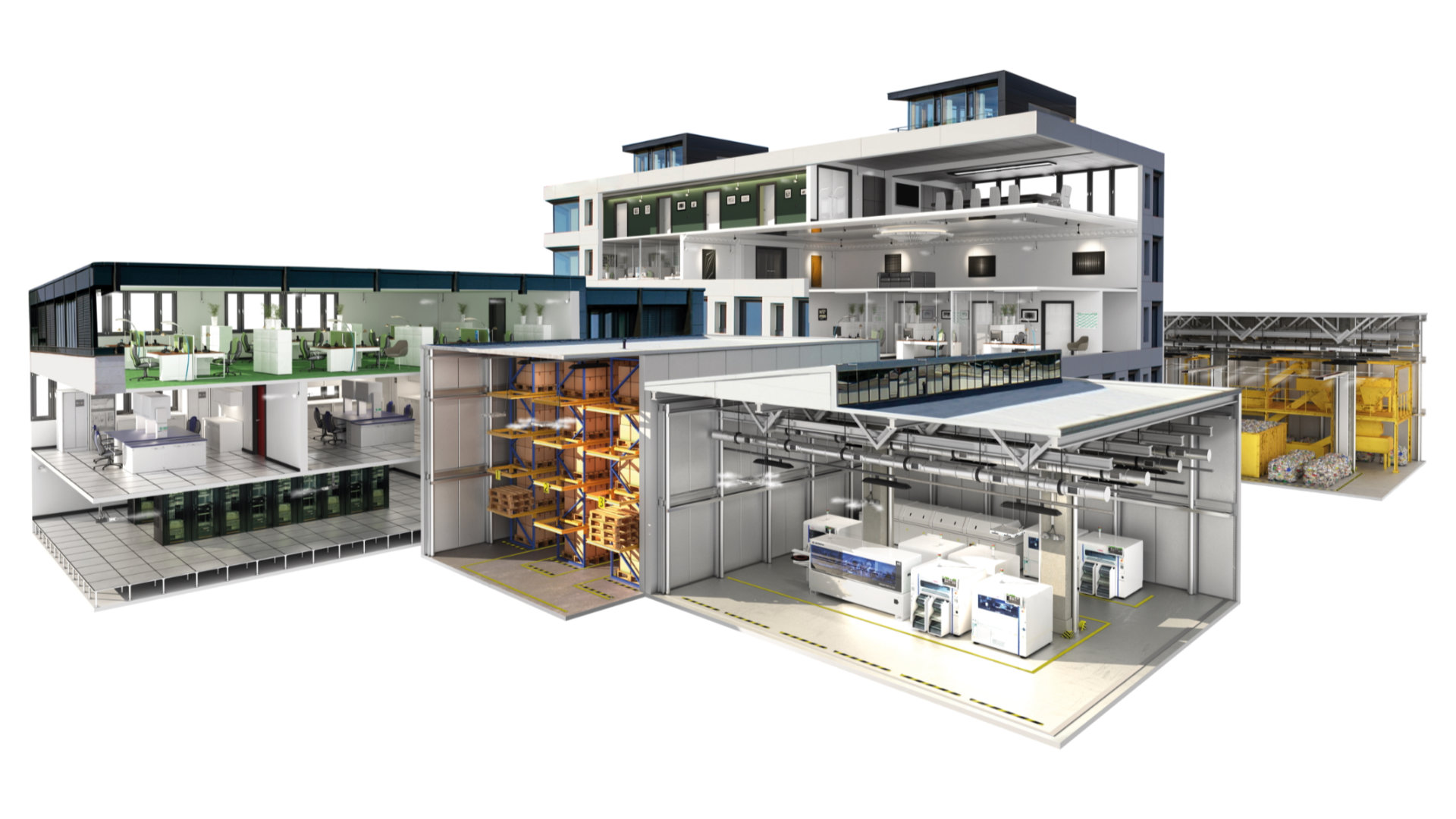

In-room humidification regulates humidity independently of any existing air-conditioning system. This means that additional humidification can always be used, even if there is no ventilation or air-conditioning system, or if humidification within the ventilation system is technically impossible or undesirable. As a result, this form of humidification is also ideal for cost-effective retrofitting in existing buildings, older properties or for building refurbishment.

When assessing the cost-effectiveness of air humidification, energy costs must be taken into account alongside the purchase and maintenance costs. Energy costs can vary significantly depending on the application for which the humidity is required, and whether additional heating is needed or a cooling effect is desired. Air humidification using high-pressure nozzles directly in the room is characterised by particularly low primary energy requirements and can also economically reduce excess heat loads.

One interesting effect of in-room humidification using high-pressure nozzles, which is of interest for many applications, is the reduction in room temperature achieved through adiabatic evaporative cooling. The complete absorption of the micro-fine atomised water droplets (aerosols) in the air causes heat to be extracted from the room. The adiabatic cooling effect achieved through air humidification can support the use of air conditioning and, in some cases, even replace it. An average reduction of between 2°C and 5°C is possible with only minimal energy consumption.

The ultra-fine water droplets produced by high-pressure nozzle humidification cause fine dust particles to be bound directly in the air. A thin film of water, which envelops the dust particles and makes them heavier, causes the dust to remain suspended in the air for a shorter time, fall to the floor more quickly and not be stirred up again. The humidity controlled by in-room humidification thus cleans the air of dust, reduces deposits on machinery and components, and protects health.

In-room humidifiers are used specifically where humidity is required. Suitable for every application and room size, ideal for retrofitting, energy-efficient and easy to maintain.
Request your free information package here and get a free thermo-hygrometer to measure your humidity!

High-pressure nozzle humidification offers flexible solutions for a variety of rooms and applications: humidification capacity, variable humidity levels, room size, ceiling height, noise sensitivity and cleanroom conditions are examples of specific requirements that can be met by humidifying the air directly within the room. Compared to other humidification technologies, high-pressure nozzle systems incur only a fraction of the energy costs. A positive side effect is the natural cooling effect of adiabatic evaporation.

In practice, various basic principles are employed to ensure controlled humidity levels. Whether direct or indirect humidification is used, and which technology is employed, depends on the building’s structural conditions and the user’s requirements regarding humidification capacity, scope, maintenance requirements, energy consumption and existing heat loads. Humidification directly within the room offers particular flexibility, especially in existing buildings.

Nozzle atomisers, steam humidifiers, ultrasonic atomisers and evaporators are commonly used operating principles that are employed in both centralised humidification and in-room humidification. Condair specialises in direct air humidification and primarily uses nozzle systems incorporating high-pressure and compressed air technology. The various systems differ in terms of energy consumption, maintenance requirements and humidification capacity.

Operational safety and hygiene must be a given for in-room humidification. The appropriate certifications ensure that humidification systems operate reliably and germ-free at all times. This not only guarantees compliance with legal requirements but also enables sustainable and cost-effective operation across a wide range of applications. Relevant for in-room humidification are the DGUV Test mark and VDI certification in accordance with 6022, Sheet 6.

Not all air humidification systems are the same. The performance profiles of the various manufacturers of in-room humidification systems vary considerably. There are numerous criteria that are important for the hygienic, low-maintenance and cost-effective operation of air humidification systems. The most important factors include maintenance concepts, system technology, hygiene measures and available certifications. Energy costs must also be taken into account when comparing different humidification systems.

To ensure optimum performance, reliability and cost-effectiveness, systems for in-room humidification must be individually tailored to the specific application and the spatial conditions. From expert advice and planning through to installation and technical after-sales service, Condair manages and implements projects from start to finish. This ensures that the in-room humidification system continues to reliably control humidity levels even after many years.


We look forward to hearing from you and discussing your requirements for in-room humidification for your application.
Click here for further information or a personal consultation.
Contact us via our contact form for in-room solutions
Find the right Condair contact persons in your region for in-room solutions