Self-cleaning mucous membranes
The self-cleaning function at different relative humidity levels


Buildings were originally constructed to protect us from a hostile environment. However, the drive to reduce energy consumption and costs has often had the opposite effect: high-tech insulation materials, optimised floor space and high occupant density lead to lower costs. Yet little attention has been paid to the consequences this has for health.
From ventilation and optimal humidity to filters, lighting and the right choice of materials, this chapter outlines effective measures for making buildings healthier. It also highlights the possibilities for a workplace risk assessment. Where complaints and symptoms arise due to dry air, systematic communication within organisations can lead to solutions for improving the indoor climate.
Buildings were originally constructed to protect us from a hostile environment. However, the increasingly intense focus on reducing energy consumption and costs has had the opposite effect: high-tech insulation materials, lightweight building structures, mechanical ventilation systems, optimised floor space and high occupant density are leading to falling costs. Little attention has been paid so far to the consequences this has for health.
The findings from the coronavirus pandemic show just how vulnerable we have become inside our buildings. An opportunity for the future: the mix of effective measures that can make buildings healthier in the future ranges from ventilation, through optimal humidity, filters and lighting, to the right choice of materials.

16 Seiten neueste Erkenntnisse über die wichtigsten Faktoren, die vor Infektionskrankheiten schützen. Ideal für den Dialog zwischen Gebäudeverantwortlichen, Nutzern und Arbeitsschutzbeauftragten, um für Neubauten oder Bestandsgebäude das richtige Paket für mehr Gesundheit zu schnüren.

In light of the coronavirus pandemic, public attention has increasingly focused on the risk of viruses in buildings. Links that have long been discussed have now come to the fore, highlighting the impact that fresh air, temperature, humidity, as well as light and building materials, can have on the spread of viruses. The indoor environment, in particular, is of paramount importance for health protection in buildings. Scientific evidence regarding the influence on the immune system and the spread of respiratory infections has increased significantly in recent years.
Viral respiratory infections are transmitted almost exclusively from person to person indoors. The most common route of transmission is airborne transmission at close range via droplets and at a distance via aerosols: viruses from an infected person are inhaled by another person and absorbed via the mucous membranes of the upper respiratory tract. Depending on the size of the particles, this is referred to as droplet or aerosol transmission. Due to their small size, aerosols are particularly light. Virus-laden aerosols can spread through the air in large rooms over a considerable period of time. Air movement and humidity are relevant to the spread, as they have a direct influence on the range, suspension time and infectivity of the aerosols.
Image: Factors relevant to a healthy indoor climate

Viral respiratory infections are transmitted almost exclusively from person to person indoors. The most common route of transmission is airborne transmission: at close range via droplets and at a distance via aerosols. Viruses from an infected person are inhaled by another person and absorbed through the mucous membranes of the upper respiratory tract. Depending on the size of the particles, this is referred to as droplet or aerosol transmission. Due to their small size, aerosols are particularly light. Virus-laden aerosols can remain suspended in the air in large rooms for a considerable period of time. Air movement and humidity are key factors in their spread, as they directly influence the range, suspension time and infectivity of the aerosols.
Allowing as much fresh air into the room as possible is the most effective method of removing virus-containing aerosols from indoor spaces. The more fresh air there is, the more the virus-laden aerosols are diluted in the indoor air. Air conditioning systems can control the amount of fresh air brought into the room and the removal of stale air from it. The key parameter is the air change rate: the higher the air change rate, the lower the risk of infection. The ideal air change rate depends on the use of the room and the number of people in it. It should be noted that a higher air change rate can increase energy consumption and lead to a drop in relative humidity. Good air quality is defined as a CO2 concentration below 1,000 ppm (parts per million).
Figure: Ranges of droplet and aerosol transmission of viruses

The airborne transmission and survival of viruses are also significantly influenced by relative humidity. The lowest risk of transmission occurs at a minimum relative humidity of 40 to 60%. This is also the range in which the human immune system is most effective, thanks to the self-cleansing action of the mucous membranes.
Aerosols consist mainly of water, salts and proteins. At a relative humidity of less than 40%, aerosols lose their water content and dry out. This results in dry aerosols, which are smaller and lighter and can remain airborne for longer. Air currents and the movements of people in the room also cause dry aerosols to be stirred up from surfaces more quickly and spread further.
In addition to their suspension behaviour, relative humidity also has a significant impact on the infectivity of the germ droplets. Below 40% relative humidity, the aerosols dry out so much that the salts they contain crystallise. This preserves the viruses, allowing them to remain infectious for longer. When inhaled, the crystallised salts dissolve again in the moist respiratory tract. The viruses, which are still infectious, are released onto the mucous membranes of the respiratory tract and can cause infections. If the relative humidity is within the optimal range of 40–60%, the water content of the aerosols evaporates only to the extent that the salt concentration increases significantly without crystallisation, and the viruses contained within do not survive.
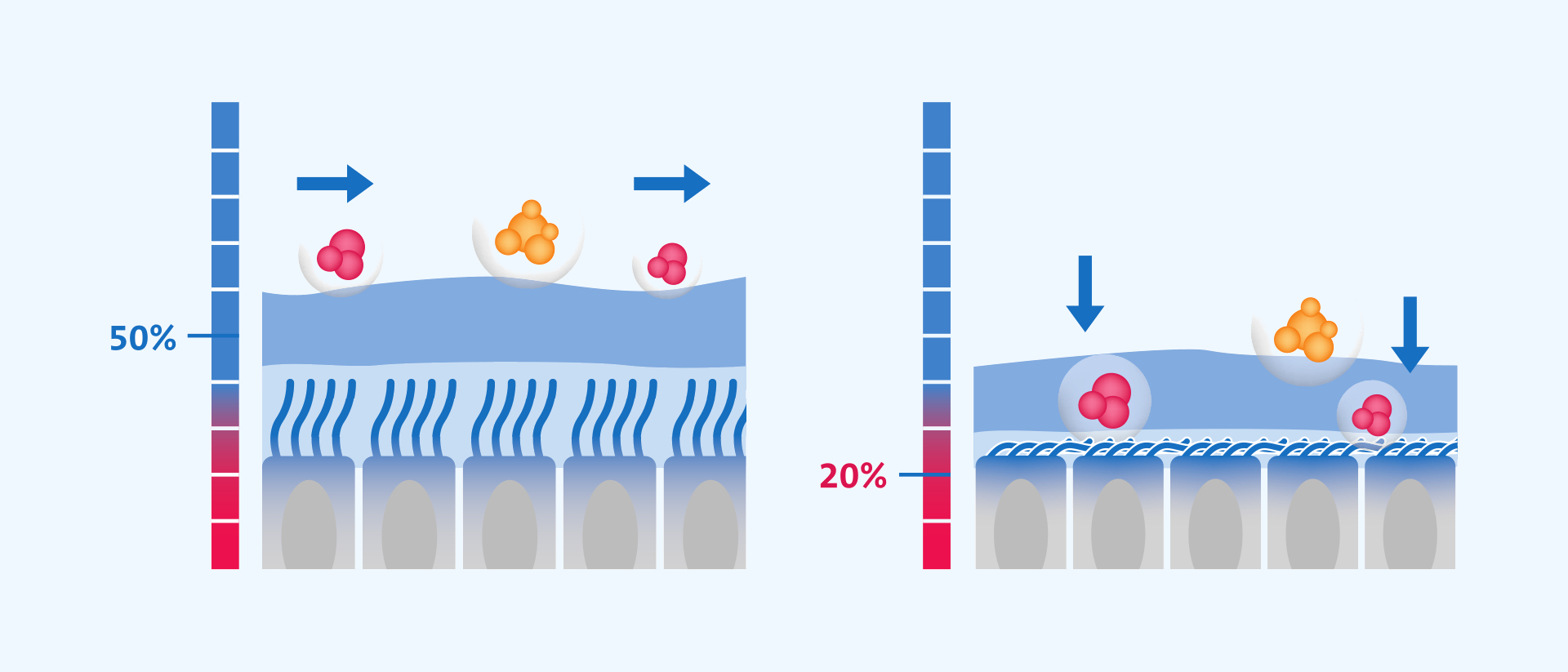
Humans are not defenceless against attacks from viruses and bacteria. The effectiveness of our immune system determines whether we fall ill and how quickly we recover. In the respiratory tract, the mucous membranes protect us from infections through their self-cleansing function. Relative humidity influences this self-cleansing function and thus the risk of respiratory infections:
As humidity falls, the removal of pathogens becomes less effective. At low humidity, water is drawn from the mucus layer. The cilia are increasingly flattened and lose their mobility. The increasing viscosity of the mucous membranes leads to a blockage of mucus flow, and the risk of infection from viruses penetrating the mucosal cells rises. If relative humidity drops to 20%, the self-cleaning process comes to a complete standstill.
Studies show that the highest transport speed, and thus the lowest risk of infection, is achieved at 45% relative humidity.
Interactive illustration: Self-cleaning function of the respiratory tract mucous membranes at different levels of humidity


Sunlight also plays an important role in actively defending against viral infections. The UV component of sunlight stimulates the body’s own immune system and leads to increased production and mobility of natural killer cells, which fight viruses and bacteria. In addition, sunlight reduces the lifespan of pathogenic microorganisms.
Natural UVA and UVB light is absent in our buildings, as window glass absorbs and reflects 100% of UV radiation. With UV LED light, which can reproduce UVA and UVB, the full spectrum of sunlight can be mimicked indoors. This would inhibit the proliferation of pathogenic agents and strengthen our immune defences.
Figure: Effect of sunlight and humidity on the time taken for 90 per cent of all SARS-CoV-2 viruses to be inactivated (Source: US Department of Homeland Security, 2020)

Whether or not a building protects against the transmission of infections depends not only on its building services but also on its use and layout. In recent years, designs that emphasise openness and transparency have become widespread in many buildings. However, the intended promotion of collaboration has a negative impact on the risk of transmission: large, heavily frequented spaces have been shown to lead to a greater diversity of microbes. Reducing the density of people and a mix of open and enclosed spaces can help curb the spread of pathogens.
The choice of flooring can also influence air quality. Compared to hard floors, textile floor coverings reduce fine dust levels, as dust is trapped in the fibres and is not stirred up again. Organic fibres also store water and have a sound-absorbing effect. Plants filter pollutants from the air, increase microbial diversity and produce oxygen. Through photosynthesis, plants absorb carbon dioxide from the air and, with the help of light, convert it into oxygen, amongst other things. Furthermore, plants can evaporate up to 90% of the water they are watered with, thereby contributing to a limited increase in humidity.
Image: Parameters for assessing indoor air quality
Healthier buildings that protect against respiratory infections are the result of many factors, which also influence one another. Not all measures are suitable for every building or technically feasible.
It is important for business leaders, facility managers, staff and health and safety officers to engage in dialogue now, at the right time, in order to put together the right package of measures to improve health in existing buildings in an effective and sustainable way.
Video: The influence of humidity on the transmission of viruses
16 Seiten neueste Erkenntnisse über die wichtigsten Faktoren, die vor Infektionskrankheiten schützen. Ideal für den Dialog zwischen Gebäudeverantwortlichen, Nutzern und Arbeitsschutzbeauftragten, um für Neubauten oder Bestandsgebäude das richtige Paket für mehr Gesundheit zu schnüren.


Wir freuen uns auf Ihre Nachricht und Ihre Wünsche zur Direkt-Raumluftbefeuchtung für Ihre Anwendung.
Hier erhalten Sie weitere Informationen oder eine persönlichen Beratung.
Hier geht es zu unserem Kontaktformular Condair Direkt-Raumluftbefeuchtung
Hier finden Sie den Berater für Ihre Region zur Condair Direkt-Raumluftbefeuchtung